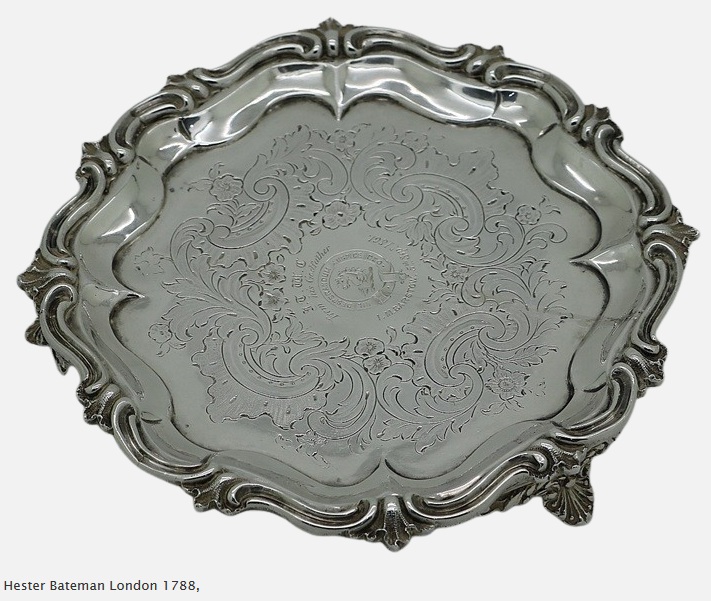
Some antique silver pieces are desirable because of their maker. Others are collected because of their age, engraving, family history or form. This fine Georgian solid silver waiter, hallmarked London 1788 and attributed to Hester Bateman, brings all these qualities together in one elegant and historically interesting piece.
Small salvers and waiters from the late 18th century have a particular charm. They are beautifully proportioned, useful as display pieces, and often carry the marks of family ownership through engraved crests, mottos and later inscriptions.
This example is especially appealing because it is connected to one of the most celebrated names in Georgian silver: Hester Bateman, one of the most famous women silversmiths in British history.
Hester Bateman – One of the Great Names in Georgian Silver
Hester Bateman is widely admired as one of the finest English silversmiths of the 18th century. After the death of her husband John Bateman in 1760, she took over the family business and registered her own mark at Goldsmiths’ Hall in 1761. She went on to build a highly successful London silver workshop, later continued by members of the Bateman family.
Her silver is especially associated with elegant domestic pieces, refined neo-classical style, bright-cut engraving and restrained good taste. Britannica describes her as being particularly noted for domestic silver of elegant simplicity, while the National Trust for Scotland highlights her remarkable rise from a poor background with no formal education to a renowned silversmith and businesswoman.
For collectors, the Bateman name has lasting appeal. Pieces bearing her mark remain sought after because they combine Georgian refinement, historical importance and the story of a remarkable female entrepreneur working in 18th-century London.
A Georgian Waiter with Armorial Interest
This solid silver waiter, or small salver, carries an engraved armorial crest featuring a horse’s head, together with the Latin family motto:
“Nil Desperandum Auspice Deo”
This translates as:
“Do not despair, trust in God.”
Armorial silver has a special appeal because it connects an object to family identity, history and inheritance. The crest and motto make the waiter more than a plain piece of Georgian silver; they give it personality and provenance.
The piece also bears a later presentation inscription:
“FJWC From his godfather I.M. Barstow 5th Sept 1861”
This later inscription adds another layer of history, showing that the waiter continued to be valued and presented as a meaningful personal gift long after it was first made.
London 1788 – A Fine 18th-Century Silver Date
Hallmarked in London 1788, this waiter was made during the reign of George III, a period strongly associated with elegant English domestic silver.
The late Georgian period produced some of the most attractive and collectable silverware, particularly smaller items for dining, tea service, presentation and domestic display. A waiter of this size would have been used for serving a glass, presenting a letter or card, or simply as a refined household object.
Today, it makes a handsome display piece and a highly collectable example of 18th-century English silver.
Important Note on the Maker’s Mark
The maker’s mark has been lightly struck and rubbed, but under magnification it can be read as Hester Bateman.
This is an important and honest detail. Many pieces of 18th-century silver show wear to marks, especially on smaller domestic items that have been handled, cleaned and used over many generations. In this case, the rubbed maker’s mark has been taken into account in the pricing, making the piece a particularly attractive opportunity for a collector who wants to acquire Hester Bateman silver at a more accessible level.
The other hallmarks are clear, and the attribution to Hester Bateman gives the waiter strong collector interest.
A Rare Opportunity for Collectors
This waiter is appealing for several reasons.
It is Georgian.
It is solid silver.
It dates to 1788.
It is attributed to Hester Bateman.
It has an engraved armorial crest and motto.
It has a later 19th-century presentation inscription.
It remains in very good antique condition.
It is priced to reflect the rubbed maker’s mark.
For collectors of Georgian silver, armorial silver, Hester Bateman silver or important named makers, it offers a great deal of interest in a beautifully manageable size.
Key Product Details
Item: Antique Solid Silver Waiter / Salver
Maker: Hester Bateman, attribution supported by rubbed but legible maker’s mark under magnification
Hallmark: London 1788
Period: Georgian
Diameter: 16.5 cm / 6.5 inches
Weight: 218 grams / 7.3 ounces
Decoration: Armorial horse’s head crest, Latin motto and later presentation inscription
Motto: “Nil Desperandum Auspice Deo”
Translation: “Do not despair, trust in God”
Later Inscription: “FJWC From his godfather I.M. Barstow 5th Sept 1861”
Condition: Very good antique condition; maker’s mark rubbed but legible under magnification
Why This Hester Bateman Waiter Is Special
This is a rare and desirable piece because it combines a famous maker, Georgian date and personal historical engraving.
It is an 18th-century London hallmarked silver waiter.
It is attributed to Hester Bateman, one of the most celebrated names in Georgian silver.
It carries an attractive armorial crest with a Latin family motto.
It has a later 1861 godfather presentation inscription, adding provenance and charm.
It is a practical size for display or collecting.
It represents an accessible opportunity to acquire Bateman silver due to the rubbed maker’s mark being reflected in the price.
Here is a link to buy this silver waiter – Click Here